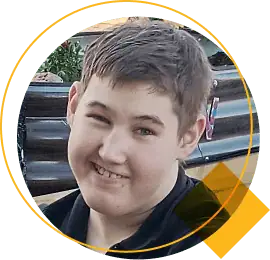
When Dakota’s mother, Stephanie, remembers what life looked like before Nexus, one word comes to mind: miserable. “He was struggling so much where he was not even able to function,” she recalled. “He didn’t have much quality of life.”
Dakota lives with severe autism, Dravet syndrome (a rare genetic disorder affecting the SCN1A gene), dysphagia, and explosive disorder. Dakota had been hospitalized repeatedly, spending more time in medical facilities than at home. His dysphagia became a source of anxiety and self-harm, and even basic outings like a doctor’s visit had become impossible. Nearly everything could trigger an outburst.
In the New Directions Program, Dakota’s interdisciplinary care team addressed every dimension of his wellbeing. One of the most pressing challenges was his dysphagia, which caused him to eat exclusively through a G-tube. Speech-language pathologist Bethany Wright, MS, CCC-SLP, guided him through safe swallowing procedures, proper posture, self-feeding, right-sized bites, and navigating different flavors and textures. After an x-ray confirmation, Dakota was cleared to have his G-tube removed. “If he hadn’t been able to have this high level of behavioral, rehabilitative, and medical intervention, it would have been hard for him to get off of the G-tube and eating again,” said Bethany.
Behavioral specialists were tackling an equally significant challenge: working through the dysregulation that had made daily life so unpredictable. At the beginning of his stay, Dakota had a behavioral emergency nearly every week. His BCBA, Stern Harris, MA, BCBA, LBA, identified triggers and introduced tools like timers and schedules so Dakota could understand what to expect. Over time, he stopped having outbursts because he trusted staff to follow through, and his one-on-one staffing requirements steadily decreased. “He was able to behaviorally regulate himself like he needed to,” said Stephanie. Additionally, the quality of his communication improved. Rather than aggression, he began using full phrases and emotion words to express himself. When peers were upset, he tried to comfort them.
Stern also helped Dakota’s family prepare for life at home with in-person discharge training. Their first structured outing to McDonald’s required an unplanned detour, a disruption that would have previously derailed everything. This time, Dakota got back in the van and rode calmly to the next stop.
Through these outings, Stern worked to build the family’s confidence, equipping them with strategies and a clear plan for when things didn’t go as expected. “[Dakota’s parents] did a fantastic job,” he said. “They were very passionate about learning and very open to talking through some of those hard things.”
Dakota went roughly six weeks without a behavioral emergency before his discharge. “Everything fell into place. It was just amazing,” Stephanie said.
The difference between the Dakota who arrived at Nexus and the one who came home is “night and day.” Stephanie had hoped treatment would return him to his baseline but was surprised by the actual outcome. “He’s beyond his baseline. He’s doing so phenomenal,” she said. “The new Dakota is the Dakota that I hadn’t seen in a long time.”
Now back home, his feeding tube is gone, and he enjoys food and drinks again with a specialized cup. He is sleeping through the night, back in school, and finally getting to be the big brother he always wanted to be.
“Dakota is an absolute ray of sunshine, a brilliant light, a clever and caring child. I know he will continue to thrive,” said Bethany.
When asked what he wanted people to know about his journey, Dakota shared a phrase from one of his favorite stories: “The wall came down.”