

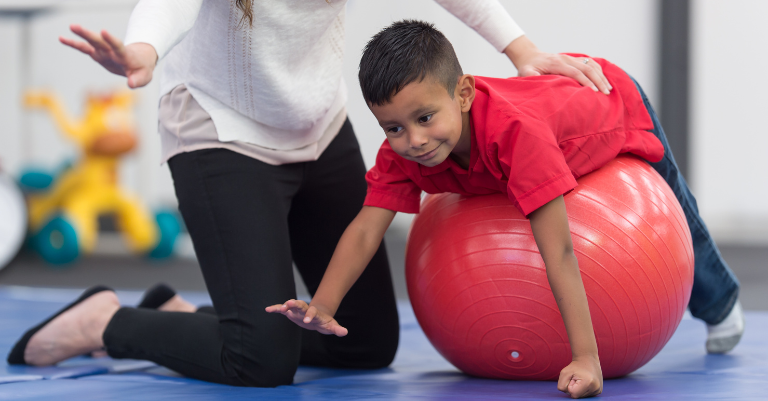
When a child sustains a brain injury, the road ahead can feel uncertain. Because young brains are still developing — forming new connections and adapting to the world around them — age plays a significant role in recovery. The timing of an injury can shape how a child thinks, learns, and relates to others in profound and lasting ways.
Why age matters in pediatric brain injury recovery.
Young brains are remarkably adaptable, a quality known as neuroplasticity — the brain’s ability to reorganize and form new neural connections.1 This flexibility can both help and complicate recovery, depending on where the injury occurs. Because neural pathways are still developing, an early injury can disrupt critical milestones.
To understand how age shapes recovery, it helps to look at what’s happening in the brain at each stage of development, and how injury can affect that growth:
- Infants and toddlers are building the foundation for movement, language, and sensory awareness. A brain injury at this stage may disrupt those early milestones, delaying speech, coordination, or emotional attachment.
- School-age children are strengthening memory, problem-solving, and social skills. When injury occurs, they may lose recently learned abilities and require structured retraining to rebuild academic or behavioral progress.
- Teens and adolescents are refining executive function and forming independence. Damage during this phase can cause emotional or social setbacks, making it harder to manage impulse control, relationships, or self-identity.
According to the Centers for Disease Control and Prevention (CDC), traumatic brain injury (TBI) is one of the leading causes of disability in children, and the effects often evolve as the child grows.² An injury that seems mild at first may later manifest as learning, attention, or emotional challenges as children continue to develop.
The cognitive footprint: Every recovery is unique.
Each child’s brain has what specialists at Nexus call a “cognitive footprint”. This describes the intricate web of neural connections, learning styles, and experiences that define how each child processes the world.
Even with similar injuries, recovery outcomes vary based on:
- Pre-injury skills and personality
- Emotional resilience and coping mechanisms
- Support systems at home and school
Research from the Journal of Head Trauma Rehabilitation shows that individualized therapy plans and family involvement play major roles in recovery success.³ The findings highlight how close collaboration between medical teams, therapists, and caregivers helps children make meaningful progress.
Understanding the phases of pediatric brain injury recovery.
Recovery after brain injury isn’t a single event; it’s a continuum. Each phase brings new milestones, challenges, and opportunities for growth. All of these milestones can look different depending on the child’s age and developmental stage.
In our Caregiver Guide, we outline the three key stages of rehabilitation:
1. Disorders of consciousness.
In the earliest stage, children may appear unresponsive or show only brief moments of awareness. Vital signs can fluctuate and physical reactions, like posturing or sweating, may signal that they are experiencing discomfort.
2. Post-traumatic amnesia or acute delirium.
As children begin to regain consciousness, confusion and agitation are common. They may not remember where they are, repeat questions, or make up stories to fill memory gaps.
3. Post-acute recovery.
Once confusion subsides, children start participating more fully in therapy. They may still learn slowly or become tired easily, but begin rebuilding independence. Emotional regulation, attention, and memory often continue to improve.
Each stage of recovery is deeply influenced by the child’s age, development, and medical complexity. The Rise Program expertly bridges these stages with continuous, coordinated care.
Can a child recover from a traumatic brain injury?
Yes. Children’s brains continue to develop well into young adulthood. This means that new growth, learning, and healing are possible long after injury — especially with structured neurorehabilitation and strong family involvement.⁴ According to the National Institutes of Health (NIH), children often regain significant function through repeated practice and adaptive learning strategies.⁵ Early, interdisciplinary care gives them the best chance to thrive.
With the right support, many children can recover from a traumatic brain injury. But “recovery” doesn’t always mean returning to who they were before. Instead, healing focuses on rediscovering abilities, building new skills, and creating pathways toward independence and confidence. Every child’s potential looks different. For some, that might mean learning to communicate in new ways; for others, it’s rebuilding balance, social connection, or emotional regulation. The goal isn’t to chase an imagined version of the past or future. It’s to help each child reach their highest possible level of function, wherever they are in their journey.
How the Rise Program for neurological injury and illness helps children reach their highest potential after a brain injury.
At Nexus Children’s Hospital, the Rise Program provides comprehensive rehabilitation for children recovering from severe brain injury, spinal cord injury, stroke, and other neurological conditions. Led by an interdisciplinary team of physicians, therapists, and behavioral specialists, the program is designed to meet children where they are, medically and developmentally.
Rise supports children through every level of recovery, from disorders of consciousness to post-acute rehabilitation. Treatment is highly individualized and may include:
- Neurostimulation and sleep/wake cycle management
- Speech, physical, and occupational therapy
- Behavioral and psychiatric management
- Caregiver training and family education
- Adaptive equipment and mobility support
For children who aren’t yet ready for intensive daily therapy, Rise offers flexible programming tailored to individual needs. Patients do not have to meet a specific therapy threshold to be admitted, and many enter the program with medically complexities, such as tracheostomies or neurostorming episodes. Families and caregivers remain active partners throughout treatment by receiving ongoing education and emotional support to help them navigate life after discharge.
With patience, structure, and a team dedicated to the whole person, progress after brain injury is always possible. Contact us or call to discuss needs, criteria, and next steps.